
Milo The Microplastic Adventure
This page shows an illustrated poem drawn and written by me as a communication piece for younger children, the paper this story was inspired from was Gopalakrishnan, Sivakumar and Kashian, 2023. Try to spot Milo in each illustration! (not to scale).

Under a striped red-and-cream stand,
Sat jars of lemons, bright and grand.
A sign read “Fresh!” in chalky white,
As children queued in sheer delight.
I was the cup, all glossy and neat,
Filled to the brim with something sweet.
Lemon and sugar, a summery drink,
I smiled with pride at each small sip.
But when the drink was gone, oh dear,
My happy grin began to disappear.
Left behind, I tipped and rolled,
Through drains I tumbled, dark and untold,
Where city lights began to sleep.
The rain came down, a rushing race,
And soon I reached the seaside place.


Out in the waves, I swirled and tossed,
Among the seaweed, feeling lost.
The sun beat down, I cracked and split,
Into tiny pieces bit by bit.
No longer cup, but specks so small,
Invisible to eyes at all.
Yet here I stayed, though light as air,
A piece of plastic everywhere.
A curious fish came darting by,
And swallowed me, without a try.
Inside its tummy, dark and tight,
I lost my sparkle, lost my light.
Then came a crab, a bird, a whale,
Each caught my pieces in their trail.
I never meant to cause them pain,
But now my joy had turned to shame.
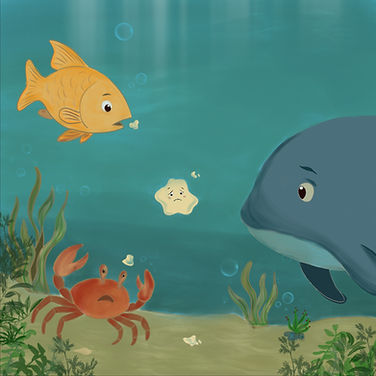
From sea to sand, from fish to plate,
My journey took a twist of fate.
A person dined and didn’t see,
A tiny bit of plastic me!
And so I travelled, far and wide,
Through ocean waves and human lives.
A tiny thing that seemed so small,
But caused big changes after all.
But maybe, if that child one day,
Recycles cups the proper way,
Then cups like me could live anew,
A cleaner world, a brighter view.
So please remember, near and far,
Wherever plastic items are,
Reduce, reuse, recycle right,
To keep our oceans clean and bright.
Milo the Microplastic Adventure is a non-traditional science communication piece designed to translate peer-reviewed research on microplastics into a form that is engaging, understandable, and meaningful for a young audience. It draws directly from the findings of Gopalakrishnan et al. (2023), which explain how larger plastic objects break down into microplastics and move through water systems, affecting marine environments and organisms. By following a narrative journey, the piece makes these scientific processes relatable without overwhelming the reader with technical detail.
Narrative and story formats have been shown to increase engagement, improve comprehension, and support emotional connection to scientific topics (Dahlström, 2014). Personifying the plastic object as “Milo” helps children follow the scientific journey as a character’s story, stories reduce cognitive barriers and make concepts easier to understand. Simple rhythm, repetition, and vivid illustrations also support memory and understanding for younger audiences (Mayer, 2020).
The piece also has solution-focused detail, emphasising responsible behaviours like recycling and reducing plastic waste, this has been linked with increased willingness to act because it offers clear, achievable steps rather than fear based action (Nisbet & Scheufele, 2009). By balancing problem awareness with positive action, the piece not only reflects the scientific content but also invites children to think of themselves as part of the solution. This approach demonstrates how communication principles can effectively bridge complex environmental science and meaningful learning for children.
References
Dahlstrom, M.F. (2014). Using Narratives and Storytelling to Communicate Science with Nonexpert Audiences. Proceedings of the National Academy of Sciences, 111(Supplement 4), pp.13614–13620. doi:https://doi.org/10.1073/pnas.1320645111.
Goldstein, C.M., Murray, E.J., Beard, J., Schnoes, A.M. and Wang, M.L. (2020). Science Communication in the Age of Misinformation. Annals of Behavioral Medicine, [online] 54(12), pp.985–990. doi:https://doi.org/10.1093/abm/kaaa088.
Gopalakrishnan, K.K., Sivakumar, R. and Kashian, D. (2023). The Microplastics Cycle: An In-Depth Look at a Complex Topic. Applied Sciences, [online] 13(19), p.10999. doi:https://doi.org/10.3390/app131910999.
Mayer, R. (2020). Multimedia Learning. Multimedia Learning. doi:https://doi.org/10.1017/9781316941355.
Nisbet, M.C. and Scheufele, D.A. (2009). What’s next for science communication? Promising directions and lingering distractions. American Journal of Botany, [online] 96(10), pp.1767–1778. doi:https://doi.org/10.3732/ajb.0900041.